
How to Write a Cover Letter for PhDs + Examples
Make a lasting impression on the selection committee. Create a professional PhD cover letter using our expert templates to achieve your academic and career goals.

- Our customers have been hired by : *Foot Note
You can have many reasons to pursue a PhD – an unrelenting desire to deepen your knowledge through research; willingness to work in academia, or a wish to cultivate your personal development and develop valuable skills.
Getting into a postdoctoral programme, however, is notoriously difficult due to limited availability. As admission committees find it hard to select the best candidate out of so many great candidates, PhD cover letters often help settle these dilemmas.
A PhD cover letter helps personalise your application, giving you a chance to address the admissions committee directly and make the case for why you’re a great fit. The way you write, format, and structure your cover letter says a lot about you as a candidate, which is exactly why it’s important you nail all three of these things.
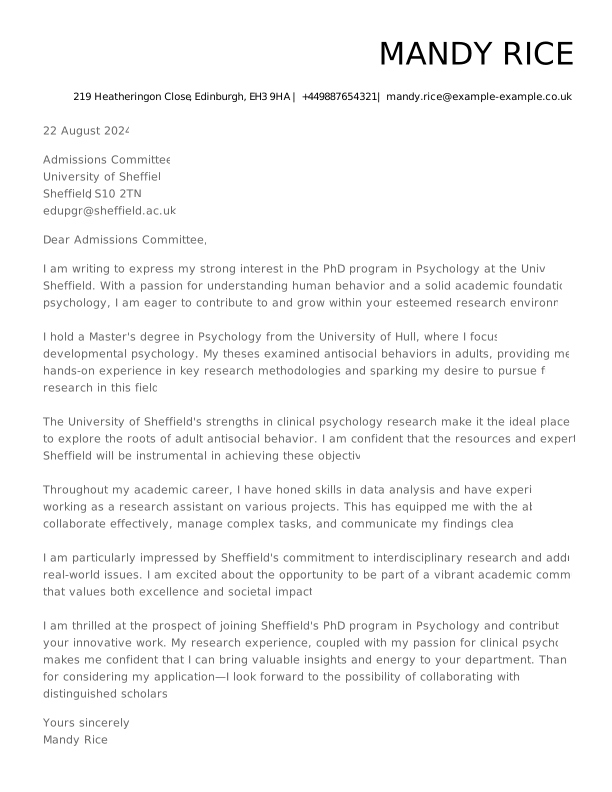
PhD cover letter example for UK programs
Write your cover letter for PhD applications with our cover letter templates – they’ll help you breeze through the process. Make note of how the cover letter examples below look, read, and feel, and make unsuccessful PhD applications a thing of the past.
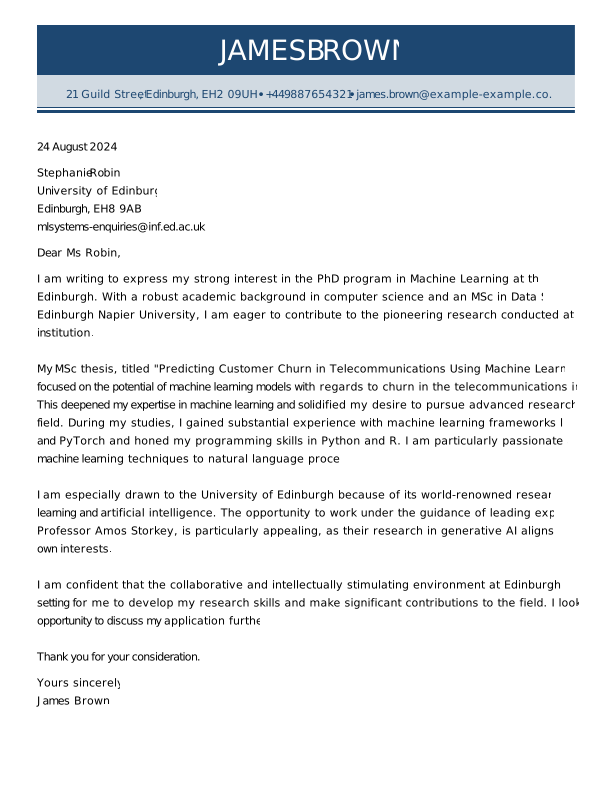
James Brown
21 Guild Street
Edinburgh EH2 09UH
07912 345 678
james.brown@example.co.uk
20 December 2025
Mandy Rice
University of Edinburgh
10 Crichton Street
EH8 9AB
mlsystems-enquiries@inf.ed.ac.uk
Dear Ms Rice,
I am writing to express my strong interest in the PhD program in Machine Learning at the University of Edinburgh. With a robust academic background in computer science and an MSc in Data Science from Edinburgh Napier University, I am eager to contribute to the pioneering research conducted at your esteemed institution.
My MSc thesis, titled “Predicting Customer Churn in Telecommunications Using Machine Learning Models,” focused on the potential of machine learning models with regards to churn in the telecommunications industry. This deepened my expertise in machine learning and solidified my desire to pursue advanced research in this field. During my studies, I gained substantial experience with machine learning frameworks like TensorFlow and PyTorch and honed my programming skills in Python and R. I am particularly passionate about applying machine learning techniques to natural language processing.
I am especially drawn to the University of Edinburgh because of its world-renowned research in machine learning and artificial intelligence. The opportunity to work under the guidance of leading experts, such as Professor Amos Storkey, is particularly appealing, as their research in generative AI aligns closely with my own interests.
I am confident that the collaborative and intellectually stimulating environment at Edinburgh will be the ideal setting for me to develop my research skills and make significant contributions to the field. I look forward to the opportunity to discuss my application further.
Thank you for your consideration.
Yours sincerely,
James Brown
Cover letter for PhD application – templates
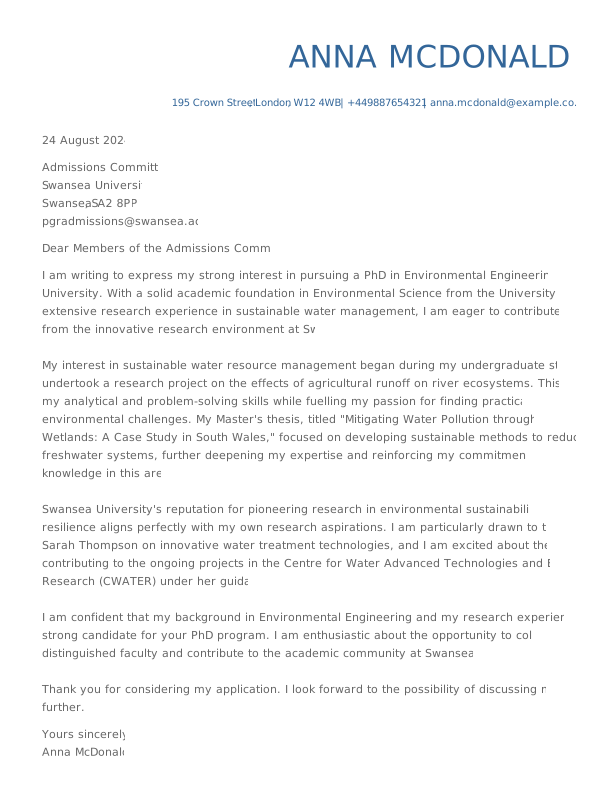
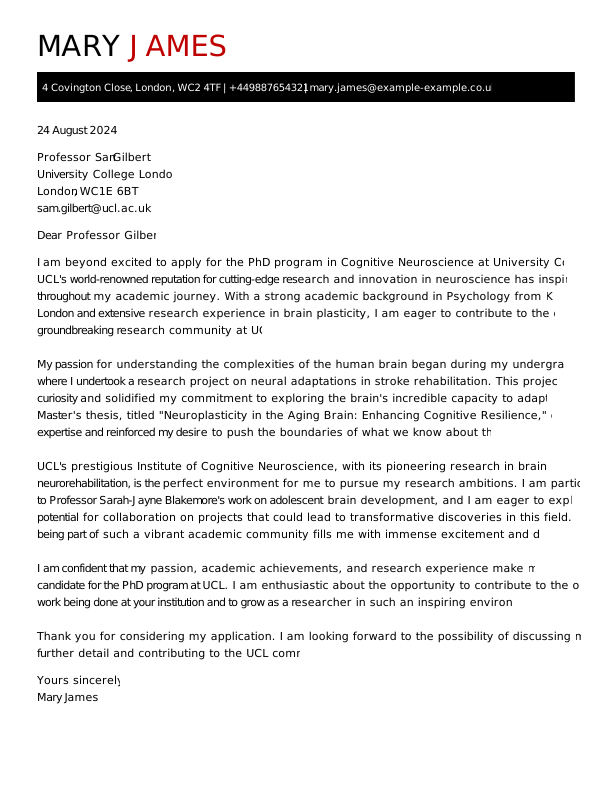
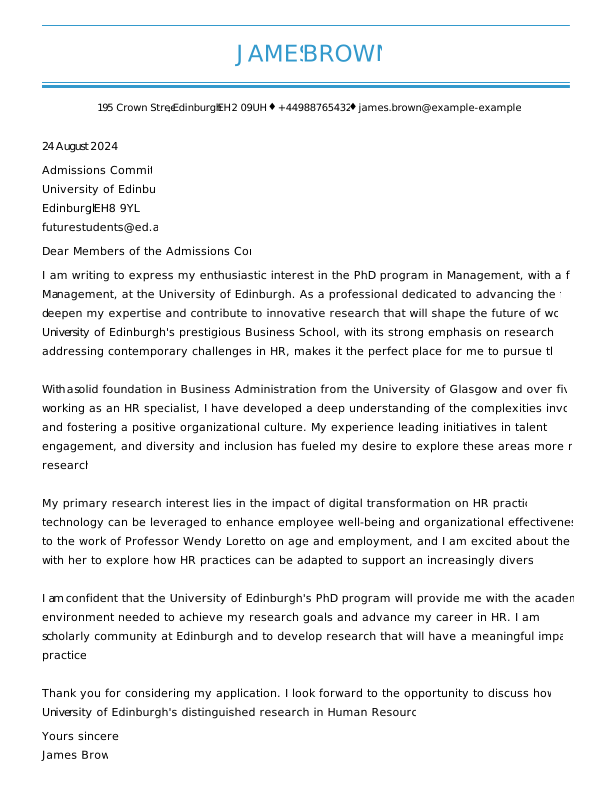
How to write a PhD cover letter
Your PhD cover letter can make or break your application – there’s no sugar-coating it. The good news is that cover letters are not rocket science, and writing yours doesn’t have to be a complete chore either.
Believe it or not, your cover letter for PhD applications is actually there for your benefit. It’s a unique opportunity for you to:
- Address the admissions committee;
- Present yourself beyond your academic transcripts;
- Convey your passion, enthusiasm, and personality, which is precisely what distinguishes an unconvincing PhD application from a highly promising and memorable one.
My step-by-step guide on how to write a PhD cover letter is here to help you make a lasting impression on the admissions committee. Keep reading to find out everything you need to get into your dream PhD programme.

Here’s your PhD cover letter step by step:
Step 1: Get your research done
As a PhD applicant, you probably know a thing or two about research, which is perfect – crafting a compelling PhD cover letter requires a bit of research, too. Try to learn more about what your chosen programme involves in terms of structure, focus, and research areas, so you can create a convincing argument as to why they should accept you.
The admissions committee will also want to know:
- Why did you pick their institution?
- What has drawn you to it?
In your answer, refer to things such as values, culture, and noteworthy achievements relating to your field of study.
Make sure to also study the application requirements carefully – they’ll help you identify the key points to cover in your PhD cover letter. The above prep can make a world of difference.
Step 2: Add your personal details
To start your cover letter, write your personal details at the top.
This includes:
- Your full name
- home address
- phone number
- email address
Be careful to include up-to-date information, so you can be contacted easily by the university.
Next, add a space underneath your details and write today’s date in the next line of text. Adding yet another space in between, write your target university’s contact information. If you know the name of the person overseeing the application process, feel free to use it. Otherwise, just the university’s name is fine, followed by the city it’s located in and the university postcode.
Adhering to cover letter format conventions may sound like an unnecessary hassle, but doing so can already say a lot about you. The last thing you want is for the admissions committee to think you’re sloppy or disorganised.
In terms of your header, it should look like this:
Samantha James
4 Bold Street
Liverpool L1 4JG
07912 345 678
samantha.james@example.com
21.12.2025
Admissions Committee
University of Liverpool
L69 7ZX
ismibpgradmin@liverpool.ac.uk
Step 3: Address the faculty
When addressing the reader in your PhD application cover letter, be professional and specific. Name the most relevant faculty member, such as the head of your department. This information is often readily available on university websites, and you may also enquire by phone or email. Personalising your PhD cover letter in this way shows initiative and consideration, both of which can only help your case.
If, for some reason, you weren’t able to obtain an actual name, don’t sweat it. An alternative, such as “Dear Admissions Committee”, is perfectly fine, and it’s highly unlikely anyone will hold it against you. As long as you steer clear of greetings such as “To Whom It May Concern” or “Dear Sir or Madam”, you have nothing to fear.
Dear Professor Campbell
OR
Dear Admissions Committee
Step 4: Write a compelling opening paragraph
The power of a good opening paragraph, both in your PhD cover letter and beyond, cannot be overstated. Your opener sets the tone, establishes context, and conveys your character.
Make a compelling PhD cover letter introduction:
- Begin by stating the programme you are applying for.
- Provide a brief professional introduction.
- Specify why you are interested in the university and the programme of your choice.
- Add a quick overview of the skills and qualities that show you’re a good fit.
I leave the finer details of how you choose to answer these questions to you. Try to establish a positive and enthusiastic tone from the get-go. Don’t forget to keep it relevant and focused by aligning your statements with programme criteria.
I am writing to apply for the PhD programme in Molecular Biology at the University of Edinburgh. I recently completed my Master’s degree at Swansea University – an experience which has solidified my expertise and passion for regulation. I am particularly excited about the opportunity to work with your university’s molecular biology research group, as its approach and direction closely align with my own research interests. I am confident that my strong academic background, research experience, and skills make me a great candidate for this programme.
OR
I am writing to apply for the PhD programme in English Literature at the University of Hull, driven by my profound interest in Victorian literature and its socio-cultural contexts. With a Master’s degree in English Literature from the University of Liverpool and a First-Class Honours undergraduate degree, I have developed a strong foundation in literary analysis and research. I believe my academic achievements, as well as my strong communication and analytical skills make me an ideal candidate for this programme.
Step 5: Highlight relevant skills and experiences
As you delve into the body paragraphs of your PhD cover letter, the stakes get even higher. This is where you truly sell the admissions committee on your suitability for your chosen PhD programme.
Consider the experiences you would like to highlight. You may choose to discuss:
- Any research you have contributed to your field,
- Relevant work experience that demonstrates your industry knowledge,
- Times you exemplified skills such as leadership or problem-solving.
As always, relevance is key, so be sure to also clarify how your goals and research interests relate to the programme and the university you are applying to. If you have a solid idea of how you want your professional future to look, you’re welcome to include it as long as you explain how this PhD programme will help you achieve this vision.
My Master’s dissertation, titled “Gender and Social Reform across the Dickensian Canon,” examined the intersections of gender and social reform in the works of Charles Dickens. This project, which culminated in a publication in Neon, allowed me to develop a nuanced understanding of how Victorian literature engages with contemporary social issues. My research involved extensive archival work and a critical analysis of primary texts, skills that I am excited to further hone in a PhD setting at your esteemed university.
OR
During the course of my academic journey, I had the opportunity to pursue a number of fascinating research topics. My most successful one investigated innovative approaches to natural language processing, namely sentiment analysis and deep learning. This research, which was presented at a machine learning conference, allowed me to experiment with and refine cutting-edge techniques, gaining hands-on experience with large datasets and model optimisation. The state-of-the-art facilities offered by your department coupled with your contributions to my field align perfectly with my research ambitions.
Step 6: Conclude on a memorable note
With all the work you’ve put into writing your PhD application cover letter, it only makes sense that you would end it on an equally powerful note.
- Start by reaffirming your enthusiasm for your chosen PhD programme.
- Reiterate how it aligns with your goals and background.
- Express your gratitude for the time they have taken to review your application.
- Include a call to action encouraging the reader to contact you to discuss your application.
If you feel it’s appropriate, you could also invite them to take a look at your portfolio or academic transcript in more depth and contact you with potential questions. Demonstrating flexibility and cooperation in this way is sure to score you extra points with the committee.
I am genuinely excited about the opportunity to contribute to the Psychology department at the University of Glasgow. My background in clinical psychology, coupled with my passion for affective science, positions me well to make meaningful contributions to your team. I would be honoured to further discuss how my experience and skills align with your needs. Thank you for considering my application; I look forward to the possibility of joining Glasgow University and contributing to its groundbreaking research.
OR
I am thrilled at the prospect of joining the University of Hull’s Economics department and contributing to the innovative work being done in environmental policy. My research experience and deep passion for sustainable computing make me confident that I can bring valuable insights and energy to your team. I am eager to discuss how I can contribute to the continued success of Hull University. Thank you very much for considering my application—I am excited about the opportunity to collaborate with such a distinguished group of scholars
Step 7: Add a professional sign-off
Seemingly a minor detail compared to the rest of your PhD cover letter, your sign-off helps tie the whole thing together.
- End your letter with “Yours sincerely” if you addressed your recipient by their last name.
- Write “Yours faithfully” if you addressed the admissions committee instead.
While less formal sign-offs such as “Kind regards” or “Sincerely” are frequently used and accepted in cover letters these days, it’s often said that the world of academia abides by its own rules, often embracing more traditional norms.
Yours sincerely,
Samantha James
OR
Yours faithfully,
Samantha James
Step 8: Proofread your PhD cover letter carefully
You probably don’t need reminding just how important it is to proofread your first drafts. Give yourself some time to rest your eyes before reading it again. What would be even better is having someone else proofread it for you – after all, spotting our own mistakes can be quite hard.
Other than that, scan for any formatting inconsistencies: mismatched fonts, varying heading sizes, or erratic spacing that impede readability. In terms of the best font for your cover letter, go with something like Arial, Times New Roman or Calibri, ranging from 10 to 12 points size-wise. Always stay mindful of your audience and the kinds of stylistic choices that may not be appropriate in academia.
Common PhD cover letter mistakes to avoid
Even strong candidates can weaken their application with small but avoidable errors. Keep the following points in mind to ensure your PhD cover letter stays clear, professional, and focused on what admissions tutors are looking for.
Avoid:
- Repeating your CV word for word instead of adding insight and context.
- Writing a generic letter that isn’t tailored to the PhD programme or university.
- Focusing only on grades and qualifications, without explaining your research interests or motivation.
- Using overly casual language or an inappropriate greeting (always address a named academic where possible).
- Making the cover letter too long – most PhD cover letters should fit on one A4 page.
- Forgetting to proofread – spelling or grammar mistakes can quickly undermine an otherwise strong application.
Key takeaways
Here are the essential things to keep in mind when writing a PhD cover letter for UK universities:
- A strong PhD cover letter explains why you want to pursue this research and why you’re a good fit for the programme.
- Always tailor your letter to the specific university, department, and supervisor.
- Highlight your academic background, research experience, and motivation, using clear examples.
- Keep your cover letter concise (around one page) and focused on quality, not quantity.
- Treat your cover letter as a complement to your CV – it should add context, not repeat it.
Finesse Your PhD Application
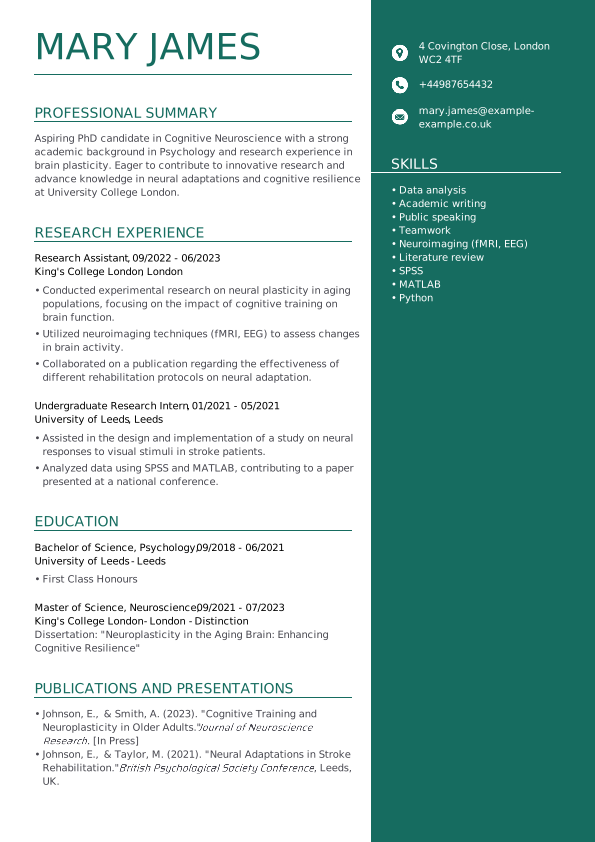
Impress even the harshest academics on the admissions committee with a flawless PhD application CV to go with your cover letter. Give our cover letter and CV builders a go, so your PhD application truly makes a statement.
Frequently asked questions about a PhD cover letter
What are the steps to write an effective PhD cover letter?
Writing a compelling PhD cover letter starts with thorough research into the university and programme of your choice. This will allow you to tailor your PhD cover letter, ensure that it is truly unique, and that it’s in line with what the admissions committee are looking for.
With all of that done:
- Start with a professional header and an appropriate salutation.
- Begin the letter by explaining your motivation for applying.
- Outline your research interests and educational background.
- Detail your achievements, your specific areas of interest, and align them with the PhD programme of your choice.
- Make sure you adhere to cover letter format conventions to achieve a polished look.
How can I write a cover letter for a PhD program abroad?
Writing a cover letter for a PhD programme abroad starts with understanding the programme requirements. Include your personal information at the beginning of your letter, and ensure you are addressing the committee in line with the conventions of the country and university of your choice.
Then, write a gripping introduction; emphasise your key strengths and relevant achievements;
and conclude by summing up your suitability for the programme in a way that leaves a lasting impression.
For more information, follow the steps outlined in the PhD Cover Letter guide above.
What is the recommended length for a PhD cover letter?
In terms of the perfect length of a cover letter for PhD applications, it should ideally be one A4 page long. That is a maximum of about 400 words since your header takes up a fair bit of space as well. The good news is that 400 words is more than enough to convey your suitability while maintaining conciseness.
Related Cover Letter Examples UK
- Internship Cover Letter Examples
- Acting Cover Letter Examples
- Healthcare Assistant Cover Letter Examples
- Recruitment Consultant Cover Letter
- Part-Time Job Cover Letter Examples
- IT Cover Letter Examples
- Asset Management Cover Letter Examples
- Business Analyst Cover Letter Examples
- Designer Cover Letter Examples
- Data Analyst Cover Letter Examples
Make Your Academic Ambitions a Reality
Creating the kind of PhD cover letter you can lay your hopes in doesn’t have to be such a daunting task. With our cover letter templates, examples, and plenty of expert tips, you’ll soon be hitting “send” on your PhD application and letting out a sigh of relief. See for yourself!
*The names and logos of the companies referred to above are all trademarks of their respective holders. Unless specifically stated otherwise, such references are not intended to imply any affiliation or association with myperfectCV.